
Navigating Seoul requires acknowledging that a language barrier is a structural obstacle. However, you do not need to rely solely on translation apps. South Korea operates a tiered system of centralized, multilingual helplines designed to bypass linguistic friction instantly.
If you attempt to resolve a complex issue using broken English or hand gestures, you are operating inefficiently. Use the following nodes.
1. The 1330 Translation Bypass (Tourism & Transport)
The most common point of failure for visitors is communicating exact destinations to taxi drivers or understanding transit staff. 1330 is your primary operational lifeline.
- The Function: The 1330 line is the Korea Tourism Organization (KTO) Travel Helpline. It operates 24/7 as a free public service.
- The Execution: Dial 1330 from any Korean phone (from overseas, dial +82-2-1330). You will be connected to a trained specialist offering assistance in English, Japanese, Chinese, and Korean.
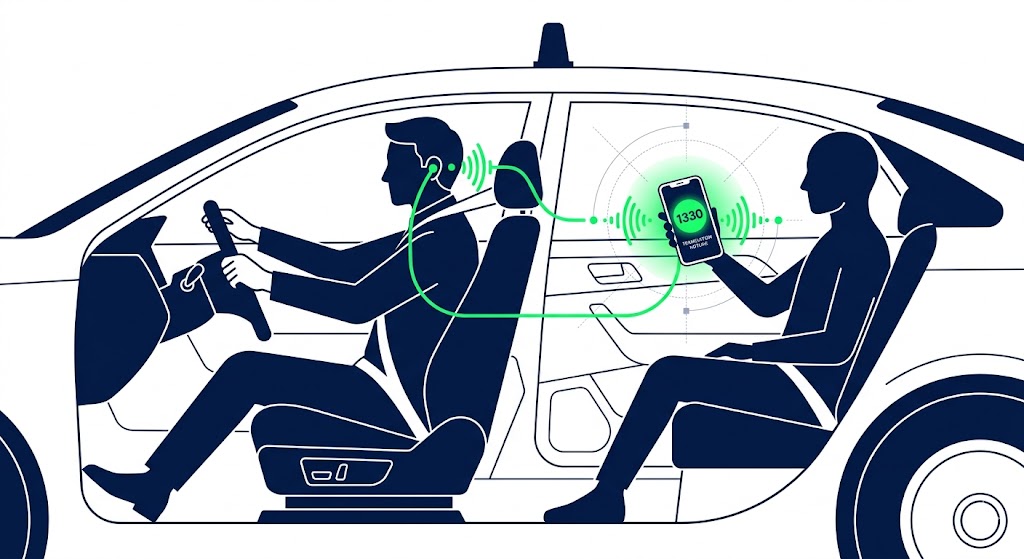
- The Three-Way Bypass: If you are in a taxi and the driver cannot read your map app, dial 1330, explain your destination to the English operator, and hand the phone directly to the driver for real-time interpretation.
2. The Emergency Matrix: 112 and 119
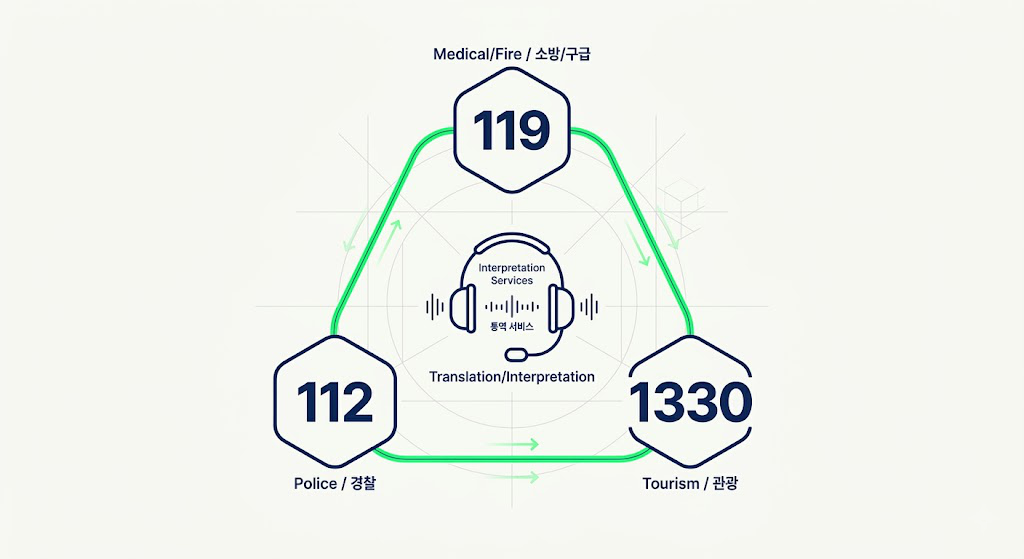
If the situation escalates from a logistical inconvenience to a physical or medical threat, 1330 is no longer the correct channel. You must switch to the direct emergency lines, both of which are equipped for foreign language speakers.
- 112 (Police & Crime): Dial 112 from anywhere in Korea without an area code. The Korean National Police Agency operates a nationwide interpretation service. Crucial Protocol: When you dial, a police officer will ask you to wait. Do not hang up when you hear a beep or waiting signal. The officer will connect an interpreter to the line to establish a three-way call.
- 119 (Fire & Medical Emergency): South Korea uses 119 for ambulance dispatch. Similar to the police, calling 119 as a foreigner will route you to a translator (often via the KTO) via a three-way call. Ambulance call-outs are entirely free, though any subsequent emergency room treatment will carry a charge.
3. The 1345 Bureaucratic Hub (Immigration & Civil Affairs)
If you are dealing with government paperwork, immigration status, or administrative civil disputes, the tourism helpline cannot assist you.
- The Function: You must dial 1345 to reach the Foreigner Comprehensive Information Center.
- The Availability: This center provides phone consultation in 20 languages. Services are available on weekdays between 09:00 and 22:00.
- The Scope: They provide third-party interpretation services specifically tailored for interactions with central administrative agencies, local governments, and public institutions.
4. The LOST112 Physical Exfiltration Portal
As mentioned in the transit protocol, lost items are absorbed into a centralized grid.
- The Process: If you lose an item of high value (wallet, phone, passport), you must physically visit a local police station to file a report, at which point the staff will issue a filing receipt.
- The Database: The data is uploaded to the LOST112 system (www.lost112.go.kr), the National Police Agency’s centralized lost and found portal. You can use this database online to track whether your item has been surrendered to any precinct in the country.